If things go dark
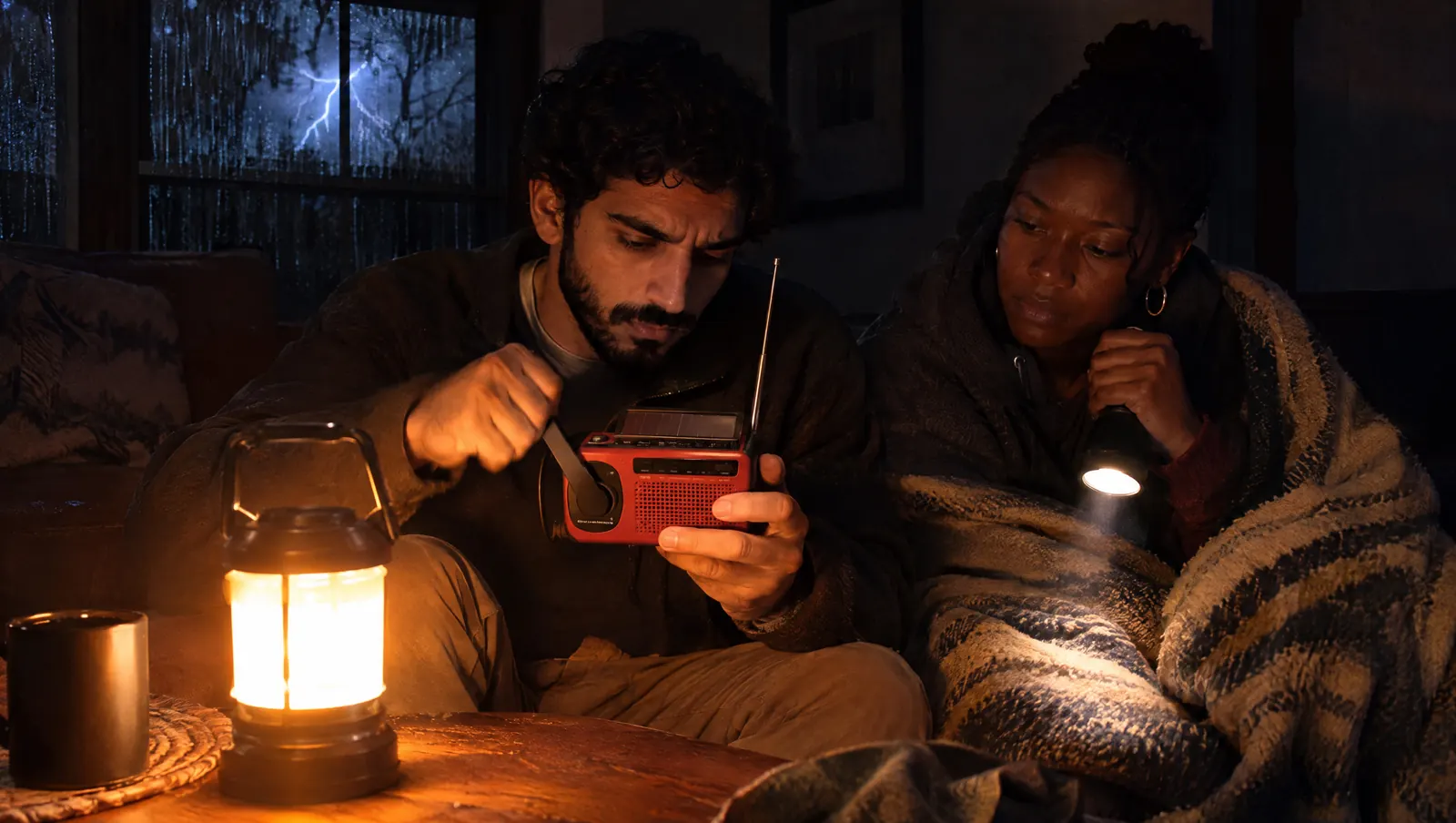
How to get news, stay in touch, keep lights on, pay for things and get through the first few days when power, internet or cell service is out.
This page is general information for preparing at home, not professional, medical, legal or safety advice for your situation; follow instructions from local officials. Updated 2026-11-21. Every line links to its source. Gear is listed for what it does, never because it will work in a particular disaster.
Get news and alerts with no internet
Do this first: Keep a battery or hand-crank radio that also gets NOAA Weather Radio, and leave emergency alerts switched on in your phone.
- NOAA Weather Radio is a government radio network that broadcasts warnings, watches and forecasts from your nearest National Weather Service office 24 hours a day, 7 days a week. NOAA National Weather Service: NOAA Weather Radio All Hazards
- It also carries alerts that aren't about weather, such as chemical spills, AMBER alerts and 911 phone outages. NOAA National Weather Service: NOAA Weather Radio All Hazards
- You need a radio made to pick it up: it broadcasts on seven channels between 162.400 and 162.550 MHz. NOAA National Weather Service: NOAA Weather Radio All Hazards
- Reception usually reaches about 40 miles from the transmitter on level ground; hills and mountains can block it, so test yours at home. NOAA National Weather Service: NWR county coverage
- Ready.gov's basic kit includes a battery-powered or hand-crank radio and a NOAA Weather Radio with tone alert (a sound that goes off when a warning comes in). Ready.gov: Build a Kit
- Wireless Emergency Alerts are official warnings sent to your phone through your carrier. There's no app and no sign-up, and they're free. NOAA National Weather Service: Wireless Emergency Alerts
- The Weather Service says these alerts aren't affected when the network is too busy for calls and texts. NOAA National Weather Service: Wireless Emergency Alerts
- When an alert comes in, follow what it tells you to do, then get details from TV or radio, NOAA Weather Radio, or another trusted source. NOAA National Weather Service: Wireless Emergency Alerts
Guides: When Cell Service Goes Down: Radios, Mesh Texting and Satellite · The Power-Out Weekend Drill
Gear for this
- Midland WR400 Deluxe NOAA Weather Alert RadioReceives NOAA Weather Radio alerts without internet or cell service and can be set to sound only for your county.Check price on Amazon (opens Amazon in a new tab)
- Midland ER310 E+Ready Emergency Crank Weather RadioAM/FM and NOAA weather radio you can power by hand crank or solar.Check price on Amazon (opens Amazon in a new tab)
As an Amazon Associate I earn from qualifying purchases.
Stay in touch when phones don't work
Do this first: Agree on one radio channel and one check-in time with your family, and write both in your Family Plan.
- FRS (Family Radio Service) walkie-talkies need no license. FCC rules let anyone eligible use personal radio services like FRS without one, unless a rule for that service says otherwise. FCC rules, 47 CFR 95.305 (eCFR)
- FRS radios are low power: the rules cap them at 2 watts on most channels and half a watt on channels 8 to 14, so expect short range. FCC rules, 47 CFR 95.567 (eCFR)
- GMRS (General Mobile Radio Service) does need a license from the FCC, and you must be at least 18 to get one. FCC rules, 47 CFR 95.1705 (eCFR)
- One GMRS license lets your immediate family use your radios, including your spouse, children, parents, brothers and sisters. FCC rules, 47 CFR 95.1705 (eCFR)
- The FCC fee schedule lists $35 for a new license of this kind. FCC rules, 47 CFR 1.1102 fee schedule (eCFR)
- A GMRS license normally lasts ten years and can be renewed. FCC rules, 47 CFR 95.1705 (eCFR)
- Amateur (ham) radio needs a license before you can transmit. FCC rules, 47 CFR 97.5 (eCFR)
- The first ham license, called Technician, takes a 35-question written test and opens all ham bands above 30 MHz. Licenses last 10 years. ARRL: Getting Your Technician License
- Mesh radios like Meshtastic are small radios that pass text messages from radio to radio, with no cell towers or internet. Each radio re-sends what it hears, so a message can hop across several radios to reach someone farther away. Meshtastic: Introduction
- Meshtastic says the LoRa radio method it uses works in most places without a license, unlike ham radio. In the U.S. the radios use 902 to 928 MHz. Meshtastic: LoRa configuration
- Range depends on the ground between you. Meshtastic's range estimates assume flat land and modest antennas, and it says a high spot like a hilltop or rooftop greatly increases range. Meshtastic: Android app radio settings
- The other person needs a compatible radio on the same settings: Meshtastic radios set to different presets can't talk to each other. Meshtastic: Android app radio settings
- Phone mesh apps like Bridgefy send messages over Bluetooth with no internet. The maker says each phone reaches about 330 feet, and messages to people farther away hop through other phones running the same app. Bridgefy (maker site)
- iPhone 14 or later can text emergency services by satellite when there's no cell or Wi-Fi coverage. You need to be outside with a clear view of the sky and horizon. Apple Support: Emergency SOS via satellite
- Apple says this satellite emergency feature is free for two years after you activate an iPhone 14 or later. Apple Support: Emergency SOS via satellite
Mesh radios: text without cell service
Guides: When Cell Service Goes Down: Radios, Mesh Texting and Satellite · Staying in Touch When Phones Struggle
Gear for this
- Motorola Talkabout T605 H2O Two-Way Radios (2-pack)A pair of FRS walkie-talkies; FRS needs no license.Check price on Amazon (opens Amazon in a new tab)
- SenseCAP Card Tracker T1000-ESmall mesh radio that pairs with your phone to send texts to other mesh radios without cell service.Check price on Amazon (opens Amazon in a new tab)
As an Amazon Associate I earn from qualifying purchases.
Light
Do this first: Put a working flashlight or headlamp where every person in your home can find it in the dark.
- Have flashlights for every household member. Ready.gov: Power Outages
- Use flashlights, not candles, if the power goes out. U.S. Fire Administration (FEMA): Candle fire safety
- If you do want a candle look, the U.S. Fire Administration suggests battery-operated flameless candles. U.S. Fire Administration (FEMA): Candle fire safety
- Ready.gov's basic kit lists a flashlight and extra batteries. Ready.gov: Build a Kit
Guides: Battery Audit: Know What You Have and Keep It Charged · The Power-Out Weekend Drill
Gear for this
- Black Diamond Spot 400-R Rechargeable HeadlampRechargeable headlamp that keeps both hands free.Check price on Amazon (opens Amazon in a new tab)
- Goal Zero Lighthouse 600 Lantern & USB Power HubLantern that lights a room and can be charged by hand crank.Check price on Amazon (opens Amazon in a new tab)
- Rechargeable AA/AAA batteriesRechargeable batteries for flashlights and radios, so you're not relying only on spares in a drawer.Check price on Amazon (opens Amazon in a new tab)
As an Amazon Associate I earn from qualifying purchases.
Power and fuel
Do this first: Put a battery carbon monoxide alarm on every level of your home before you ever run a generator.
- Plan for batteries and other backup power to meet your needs when the power goes out, and keep a power bank (a portable phone battery) on hand. Ready.gov: Power Outages
- If anyone uses a medical device that runs on electricity, or a medicine that must stay cold, talk with your medical provider about a power outage plan. Ready.gov: Power Outages
- Never run a portable generator inside your home or garage, even with doors and windows open. CPSC: Carbon monoxide
- Run it outside only, more than 20 feet from windows, doors and vents. CDC: About carbon monoxide poisoning
- Never use a generator in an attached garage, even with the door open, and point the exhaust away from the house. NFPA: Generator safety tip sheet
- Let a generator cool down before refueling; never refuel it while it's hot. NFPA: Generator safety tip sheet
- Put battery-operated or battery back-up carbon monoxide (CO) alarms near every sleeping area. CDC: About carbon monoxide poisoning
- CPSC says to put a CO alarm on every level of your home and outside sleeping areas, and check the batteries regularly. CPSC: Carbon monoxide
- If you think someone has CO poisoning, get outside to fresh air right away, then call 911. Headache, dizziness, weakness, nausea and confusion are common signs. CPSC: Carbon monoxide
- Don't use gas-powered engines, including generators, in enclosed spaces. EPA: Protect your family from carbon monoxide poisoning
- Store fuel only in approved containers that close tightly and don't leak. Gas cans are usually red, kerosene blue and diesel yellow. Florida Dept. of Agriculture and Consumer Services: Storm preparation
- Use only UL-listed gas cans with a UL or ASTM stamp. Milk jugs and food containers don't hold in the liquid or the fumes. National Park Service: Fire Prevention 52, gas cans
- Set the can on the ground to fill it, never in a truck bed or trunk. Florida Dept. of Agriculture and Consumer Services: Storm preparation
- Store fuel outside living areas. NFPA: Generator safety tip sheet
- The U.S. Fire Administration suggests keeping gasoline and propane in a shed away from your home. U.S. Fire Administration (FEMA): Basement and garage fire safety
- A fuel stabilizer helps keep stored gas usable. Properly stored fuel can be kept through a hurricane season and then poured into your car if you didn't need it. Florida Dept. of Agriculture and Consumer Services: Storm preparation
Guides: Generators: Test Runs, Spare Parts, and a Safe Cord Plan · Fuel Storage: How Much Gas to Keep and How to Keep It Safe · Propane: Topping Off, Storing, and Checking Your Tanks · Battery Audit: Know What You Have and Keep It Charged · Living Off the Grid for Days or Weeks: Water, Power, Heat, Food and Sanitation
Gear for this
- Kidde Battery-Operated Carbon Monoxide AlarmBattery carbon monoxide alarm that sounds when CO builds up indoors.Check price on Amazon (opens Amazon in a new tab)
- EF EcoFlow DELTA 2 Portable Power Station (1,024Wh LiFePO4)Rechargeable battery power station for phones, lights and small appliances.Check price on Amazon (opens Amazon in a new tab)
- Scepter SmartControl 5-Gallon Gas Can5-gallon gas can for storing generator and car fuel.Check price on Amazon (opens Amazon in a new tab)
As an Amazon Associate I earn from qualifying purchases.
Water and food
Do this first: Store at least 1 gallon of water per person per day, for at least 3 days.
- Store at least 1 gallon of water per person per day for 3 days, and try for a 2-week supply if you can. CDC: How to create an emergency water supply
- Keep at least a several-day supply of food that doesn't need a fridge, plus a manual can opener. Ready.gov: Build a Kit
Guides: Emergency Water: How Much to Store, How to Keep It, How to Make It Safe · Build a Backup Pantry in Three Tiers
Gear for this
- Reliance Aqua-Tainer 7 Gallon Rigid Water ContainerReusable 7-gallon jug for storing drinking water.Check price on Amazon (opens Amazon in a new tab)
- ReadyWise 72-Hour Emergency Food KitPackaged food kit sized for about three days.Check price on Amazon (opens Amazon in a new tab)
As an Amazon Associate I earn from qualifying purchases.
Money when card payments stop
Do this first: Keep a small amount of cash at home, in small bills, somewhere safe.
- Keep a small amount of cash at home in a safe place. Ready.gov: Financial Preparedness
- Small bills matter because ATMs and credit cards may not work during a disaster, when you need to buy supplies, fuel or food. Ready.gov: Financial Preparedness
- Ready.gov's list of extra emergency supplies includes cash or traveler's checks. Ready.gov: Build a Kit
- Store important documents in a safety deposit box, on an external drive or in the cloud. Ready.gov: Financial Preparedness
- FEMA and Operation HOPE publish a free Emergency Financial First Aid Kit to help you plan. Ready.gov: Financial Preparedness
Guides: If Your Bank or Payments Are Down
Gear for this
- SentrySafe Fire/Water File ChestLockable fire- and water-rated box for cash and paper documents at home.Check price on Amazon (opens Amazon in a new tab)
As an Amazon Associate I earn from qualifying purchases.
A 72-hour checklist
Do this first: Check these off in your Family Plan, then set a reminder to check them again.
- After an emergency, you may need to get by on your own for several days. Ready.gov: Build a Kit
- Water: 1 gallon per person per day for at least 3 days. CDC: How to create an emergency water supply
- Food: at least a several-day supply of non-perishable food, and a manual can opener. Ready.gov: Build a Kit
- A battery-powered or hand-crank radio, and a NOAA Weather Radio with tone alert. Ready.gov: Build a Kit
- A flashlight and extra batteries. Ready.gov: Build a Kit
- A first aid kit. Ready.gov: Build a Kit
- A whistle to signal for help. Ready.gov: Build a Kit
- A dust mask, and plastic sheeting, scissors and duct tape for sheltering in place. Ready.gov: Build a Kit
- Moist towelettes, garbage bags and plastic ties for personal sanitation. Ready.gov: Build a Kit
- A wrench or pliers to turn off utilities. Ready.gov: Build a Kit
- Local maps. Ready.gov: Build a Kit
- A cell phone with chargers and a backup battery. Ready.gov: Build a Kit
- Cash, in small bills. Ready.gov: Financial Preparedness
Make your Family Emergency Plan
Guides: The Power-Out Weekend Drill · Your Home Readiness Plan · Emergency Water: How Much to Store, How to Keep It, How to Make It Safe · Build a Backup Pantry in Three Tiers
Gear for this
- Surviveware Small First Aid KitReady-made first aid kit (add your own medicines).Check price on Amazon (opens Amazon in a new tab)
- Anker Power Bank (20K, 87W, Built-In USB-C Cable)Power bank that recharges phones without wall power.Check price on Amazon (opens Amazon in a new tab)
As an Amazon Associate I earn from qualifying purchases.