When Cell Service Goes Down: Radios, Mesh Texting and Satellite
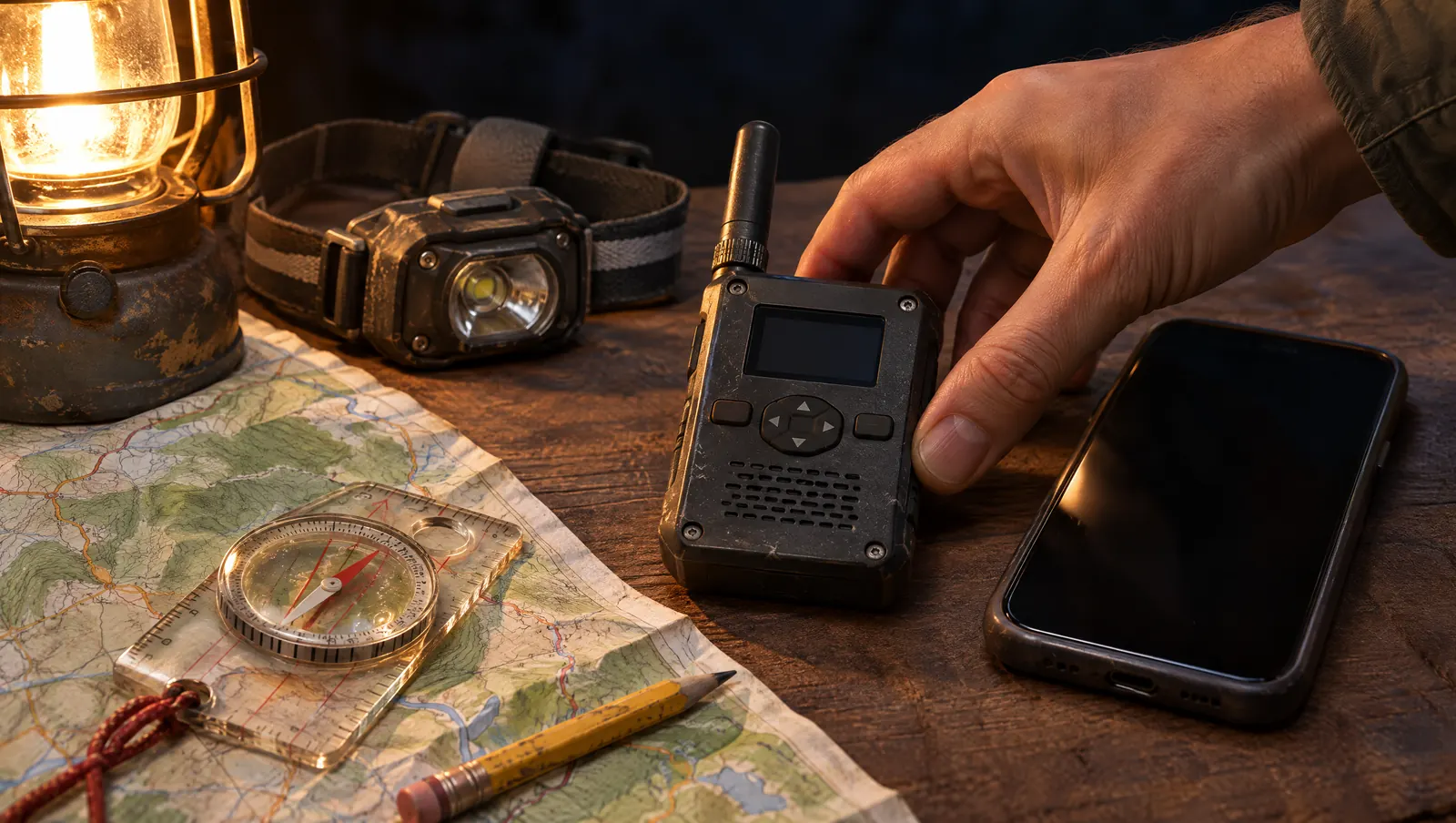
Every way to stay in touch when phones stop working: which radios need a license, what each one costs to start, how far it reaches, and a simple family plan that ties it together.
⚠ In a real emergency, try 911 first
If someone's life is in danger, call 911 first, even if your phone shows weak or no service. On an iPhone 14 or later, if the call can't connect, the phone can try to text emergency services through a satellite.[14] Pixel 9 and later phones (except the Pixel 9a) have a similar Satellite SOS feature.[15] Both need you to be outside with a clear view of the sky.[14][15] Any CB or GMRS channel may be used to call for help, and CB channel 9 is set aside only for emergencies and helping travelers.[1]
In a big storm or outage, phone lines can get overloaded or go down.[18] You don't need to become a radio expert to stay connected. You need two or three backup ways to hear warnings and reach your people, and a plan everyone knows. This guide walks through each option in plain words: whether you need a license, roughly what it costs to start, and how far it really reaches. Get the printable family comms plan in your $15 Family Plan.
How much do I need?
Three ways to hear, two ways to talk. Hear warnings through phone alerts, a weather radio, and local AM/FM.[19][16] Reach family by text through an out-of-area contact, plus one radio option that needs no cell network.[18] For a family that wants radios with no paperwork, FRS or mesh radios need no license.[1][10] For more reach, one $35 GMRS license covers your immediate family for 10 years.[2][3]
Start with your phone: text first
When local lines are swamped, a short text or a call to someone far away can get through more easily than a local call.[18] Keep messages short so they go out on the first try.
- Text first, and call only if you need to talk.
- Keep emergency alerts switched on. Wireless Emergency Alerts are free, need no sign-up, and still arrive when the network is too busy for calls and texts.[19]
- Keep a charged power bank for every phone, and turn down screen brightness to stretch the battery.
Satellite texting on newer phones
Some newer phones can send texts through satellites when there's no cell signal or Wi-Fi.
- iPhone 14 or later: Emergency SOS via satellite lets you text emergency services and share your location when you have no cell or Wi-Fi coverage.[14] In the U.S., iPhone 14 or later on iOS 18 or later can also send regular texts to friends and family through a satellite. Apple says that feature shouldn't be used in emergencies, and that regular satellite texting depends on your carrier.[13]
- Cost: Apple says its satellite emergency feature is free for two years after you activate an iPhone 14 or later.[14]
- Google Pixel: Satellite SOS works on Pixel 9 and later phones, except the Pixel 9a. Google Messages must be your default texting app.[15] Google's page doesn't list a price.
- Other phones and carriers: some carriers sell satellite texting plans. Ask yours what your phone supports.
- Limits: you must be outside with a clear view of the sky. Trees, hills and buildings can block the signal.[13][15]
Radios that only listen: NOAA Weather Radio and AM/FM
Listen-only radios need no license and keep you informed when the internet and TV are out.
- NOAA Weather Radio All Hazards is a government network that broadcasts warnings, watches and forecasts from your nearest National Weather Service office around the clock, plus non-weather alerts like chemical spills. It needs a radio that tunes its seven channels between 162.400 and 162.550 MHz.[16]
- Reception usually reaches about 40 miles from a transmitter on flat ground. Hills can block it, so test yours at home. Program your county's SAME code (a county number) so the radio only sounds off for your area.[17]
- AM/FM radio brings in local news stations. The Red Cross includes a battery-powered or hand-crank radio in its basic kit.[20] Hand-crank and small solar radios recharge themselves, so you're not stuck when batteries run out.
FRS: walkie-talkies with no license
FRS (Family Radio Service) is the most common kind of walkie-talkie. The FCC describes it as a short-distance, two-way voice service between low-power handheld radios.[1]
- License: none. Anyone can use FRS radios.[1]
- Power: the rules cap FRS radios at 2 watts on most channels and half a watt on channels 8 to 14.[1] Low power means short range.
- Range: don't trust the miles printed on the box. Real range depends on hills, buildings and trees. Walk your neighborhood with a family member and find out for yourself.
- Cost to start: usually the cheapest two-way option. A basic pair is an inexpensive purchase.
GMRS: more power, one license covers the family
GMRS (General Mobile Radio Service) can talk with FRS radios, but allows more powerful radios and repeaters (relay stations that pass your signal farther).[1][2]
- License: you need an FCC license, and you must be at least 18 to get one. There's no test.[2]
- Who it covers: one license lets your immediate family use your radios. The FCC defines that as your spouse, children, grandchildren, stepchildren, parents, grandparents, stepparents, brothers, sisters, aunts, uncles, nieces, nephews and in-laws.[2]
- Fee and term: the FCC's fee schedule lists $35 for a new GMRS license,[3] and a license normally lasts 10 years.[2] Check the FCC's GMRS page for the current fee before you apply.[4]
- How to apply: online through the FCC's licensing system, starting from the FCC's GMRS page.[4][21]
- Power and range: mobile and base radios may use up to 50 watts on the main channels, far more than FRS.[1] Handheld range is still limited by terrain. A car or house radio with an outside antenna, or a local repeater, reaches much farther.
- Texting and location: GMRS handhelds are allowed to send short text messages and location data to another GMRS or FRS radio.[1]
Ham radio: the Technician license
Amateur ("ham") radio is the biggest step up. The FCC created it partly to supply a pool of people who can help with communications during emergencies.[7] There are over 600,000 licensed hams in the U.S.[7]
- License and exam: the first license is called Technician. You pass one 35-question written test on rules, safe operating and basic radio ideas.[5] Find a test session near you with the ARRL exam finder: arrl.org/find-an-amateur-radio-license-exam-session.[9] Before test day you must get an FCC Registration Number (FRN).[6]
- Cost to start: the exam session fee is usually $15 or less, and the FCC charges a separate $35 fee for a new license.[6][3] For test-takers under 18 at ARRL sessions, ARRL covers the FCC fee and the exam fee drops to $5.[6] ARRL says study materials usually cost less than $40, and a first radio and getting on the air usually cost less than $200.[7]
- Term: licenses last 10 years before renewal.[5]
- What it unlocks: all ham frequencies above 30 MHz, where handhelds keep you in touch with other hams in your area.[5] That includes local repeaters: ham stations that re-send your signal on a different channel at the same moment, so a small handheld can be heard across a wide area.[22] The 2-meter band, the most popular ham band, is open to Technicians.[22][5]
- Nets and ARES: a net is a scheduled on-air meeting where hams check in one at a time. Joining a local net is the easiest way to practice. ARES (the Amateur Radio Emergency Service) is a volunteer group of licensed hams who register their skills and equipment and provide communications for community events and disasters.[8]
Mesh texting: Meshtastic and MeshCore
Mesh radios are small, battery-powered radios that pass short text messages from radio to radio, with no cell towers and no internet. They use LoRa, a long-range, low-power radio method.[10][12]
- License: Meshtastic says LoRa is available in most regions without a license, unlike ham radio.[10] In the U.S., these radios use the 902 to 928 MHz band.[11]
- How it works: each Meshtastic radio re-sends the messages it hears, so a text can hop across several radios to reach someone farther away.[10] By default a message makes up to 3 hops.[11] MeshCore works a little differently: "repeater" radios placed up high carry the network, and "companion" radios connect to your phone for messaging.[12] The two systems run on similar hardware but don't talk to each other, so pick the one your local group uses.
- Privacy: both say messages are encrypted.[10][12]
- Range: it depends on terrain, buildings and how high the antenna sits. MeshCore says LoRa can reach 10 km (about 6 miles) or more with a clear line of sight.[12] Radio to radio at street level, expect much less. Test it.
- Cost to start: Meshtastic describes the radios as inexpensive.[10] You need at least two.
A simple starter setup:
- Get two or more radios, one per person or household you want to reach. In the U.S., buy the 915 MHz version.
- Screw on the antenna before you power the radio on. Turning it on without an antenna can damage it.[23]
- Pair each radio with a phone over Bluetooth and use the app to send messages.[10][23]
- Set the region to US. A Meshtastic radio won't transmit until you do.[11]
- Send a test message across the house, then across the neighborhood. If messages don't reach, a radio placed high up, like near an upstairs window, helps the most.[12]
More on mesh radios, with starter kits: Off-grid texting: mesh radios.
CB radio
CB (Citizens Band) is a two-way voice service for personal and business use, including help for travelers on the road.[1]
- License: none. The FCC lets anyone use CB without an individual license.[1]
- Emergency channel: channel 9 may only be used for emergencies and traveler help.[1]
- Power: CB radios are capped at 4 watts for regular AM or FM voice.[1]
- Range: short to medium, and it changes a lot with antenna size, terrain and conditions. CB is most useful in a vehicle, especially on highways.
Your family comms plan
Gear only helps if everyone knows what to do with it. Write this down and keep copies in every go-bag.
- Out-of-area contact: pick one person far enough away that the same disaster won't hit them. Everyone checks in with that person.[18]
- Rally points: pick two meeting spots, one right outside your home for something sudden like a fire, and one outside your neighborhood in case you can't get home.[18]
- Main radio channel: write down one channel for your family (for example, FRS channel 3 or your mesh channel name), plus one backup channel.
- Check-in times: radios drain batteries when they're always on. Agree to turn them on at set times, like the top of every hour for 5 minutes.
- Order of tries: text first, then call, then the out-of-area contact, then radio at check-in time, then the rally point.
- Practice: try it once on a normal day so everyone knows how the radios work.
Checklist
Mistakes to avoid
- Buying radios and never testing how far they really reach
- Using GMRS channels without getting the FCC license first
- Expecting satellite texting to work indoors or under trees
- Leaving radios on all day and finding the batteries dead when you need them
- Buying mesh radios for the wrong country's frequency
- Having radios but no agreed channel or check-in time
Do this this weekend
Sit down with your household for 20 minutes. Pick your out-of-area contact, two rally points, one radio channel and a check-in time, and write them on a card for each person.[18] Then turn on your weather radio and make sure it picks up your local station.[16]
Gear that helps
As an Amazon Associate I earn from qualifying purchases. We list items for why they matter, never by price or ratings. Disclosure
- NOAA and world-band radiosNOAA weather radio with alert (SAME)Wakes you for warnings in your county even when cell service is down.Check it (opens retailer site)
- NOAA and world-band radiosHand-crank / solar emergency radioAM/FM and weather bands with no batteries needed.Check it (opens retailer site)
- Scanners and handheld radiosFRS two-way radios (no license)Lets family members talk nearby without cell service; FRS needs no license.Check it (opens retailer site)
- Scanners and handheld radiosDigital scannerLets you listen to local emergency radio traffic where it is legal to do so.Check it (opens retailer site)
- Batteries and USB-C chargersRechargeable AA/AAA batteriesRechargeables plus a charger mean you aren't relying only on what's in the drawer.Check it (opens retailer site)
- Batteries and USB-C chargersUSB-C multi-battery chargerCharges AA and AAA batteries from a power bank or solar panel when the grid is down.Check it (opens retailer site)
Sources
- FCC Rules, 47 CFR Part 95: Personal Radio Services (FRS, CB and GMRS), 2024 edition Federal Communications Commission, via U.S. Government Publishing Office
- 47 CFR 95.1705: GMRS individual licenses, eligibility, who may operate, license term Federal Communications Commission, via U.S. Government Publishing Office
- 47 CFR 1.1102: Schedule of application fees (personal licenses, including GMRS and amateur radio) Federal Communications Commission, via U.S. Government Publishing Office
- General Mobile Radio Service (GMRS) Federal Communications Commission
- Getting Your Technician License ARRL, the national association for amateur radio
- What to Bring to an Exam Session ARRL
- What is Ham Radio ARRL
- Amateur Radio Emergency Service (ARES) ARRL
- Find an Amateur Radio License Exam Session ARRL
- Introduction to Meshtastic Meshtastic project
- LoRa Configuration (region and hop settings) Meshtastic project
- MeshCore MeshCore
- Use Messages with satellite on your iPhone Apple Support
- Use Emergency SOS via satellite on your iPhone Apple Support
- Satellite SOS on Pixel Google Pixel Phone Help
- NOAA Weather Radio All Hazards NOAA National Weather Service
- NOAA Weather Radio County Coverage and SAME Codes NOAA National Weather Service
- Make a Disaster Preparedness Plan American Red Cross
- Wireless Emergency Alerts NOAA National Weather Service
- What Do You Need in a Survival Kit American Red Cross
- Universal Licensing System (ULS) Federal Communications Commission
- VHF/UHF and Repeaters: The Basics (QST Washington Mailbox) ARRL
- Getting Started Meshtastic project
Related guides
Living Off the Grid for Days or Weeks: Water, Power, Heat, Food and Sanitation
How to keep a household running when the power, water or stores are out for a while: how much water to keep, safe backup power, staying warm or cool, rotating food, and handling the bathroom.
PracticeBasic Survival Skills: First Aid, Fire, Shelter, Navigation and Signaling
The handful of skills worth learning before you ever need them: basic first aid, safe fire, staying warm and dry, finding your way without GPS, and calling for help.
CommunicationsStaying in Touch When Phones Struggle
How to get warnings and reach your people when cell service is jammed or the power is out.
CommunicationsGetting Out: Go-Bags, Routes and When to Leave
What to pack, where to go and how to leave early and calmly if you're told to evacuate.
PracticeYour Home Readiness Plan
One plan that organizes home prep into five areas and builds it up in stages, starting with 3 days.
PracticeThe Power-Out Weekend Drill
Practice a planned power outage at home for a day so you find the gaps while it's easy to fix them.
EnergyBattery Audit: Know What You Have and Keep It Charged
Count every battery size your gear uses, keep coin cells away from kids, keep chargers and power banks topped up, and size a power station with simple watt-hour math.